

So, that beautifully bold Scottish Wildcat. What more might she have to teach us?
There’s something curious to me about how we use the word wild—what it indicates, and also, what it doesn’t indicate.
I also can’t help but continue to chew on the ways an untrained eye (including my own!), sees what looks just like a domesticated tabby cat when looking at a Scottish Wildcat. Even though I’ve been shown the differences, if I’m not straining to notice those distinctions, what I see before me looks like, well, a cat, minus the wild designation. And rather than going down the road of zoology here, I’d love to play with some metaphors we might glean from how we see these Highland Tigers.
Before I moved to Scotland, I started to enjoy cold plunges in the mountains of Tennessee, preparing myself for swims in the North Sea. Once I arrived on this side of the Atlantic, I started to notice that people called here called this wild swimming. Part of me loved this, it felt fitting as I like to consider myself a wild woman, untamed, adventurous, and at times a little too feral for the constraints of the culture around us. And at the same time, another part of me found this curious, starting to wonder why we use this word—wild—in the ways that we do.
Sometimes we use the word wild to denote animals, plants, and places that are in their most natural form. In this way, we’re saying something about their rootedness and belonging — all just as they’re meant to be. There’s a sense of the puzzle pieces being placed just right, nothing’s been altered or messed with. They’re real and raw and wonderful. For the Scottish Wildcat that’s being rewilded, she’s stepping into her truest home. The place in which her little body knows how to belong most naturally. She simply fits.
We also sometimes use the word wild to describe people as uncivilized, unrestrained, or chaotic. And while I know that people are not cats (although sometimes I wish I could nap all day in the sun…), I can’t help but wonder why we use this same word in such different ways depending on the facets of creation that we’re referring to.
We’d never look at a glorious meadow exploding with wildflowers and think, Oh wow, these flowers are much too uncivilized, unrestrained, and chaotic. And if this is someone’s response, I’d like to suggest it’s simply silly, if not also shaped by societal scripts that have conditioned us to value control and dominance in ways that suffocate beauty and freedom.
When we hear about projects that are helping rewild animals like the Scottish Wildcat, even if we secretly might wish to have our own little litter of highland tigers in our home, we can clearly see these wildcats are where they belong as their paws anchor on the earth beneath them in the expansive Scottish landscape. We don’t think, These cats are far too feral and uncontrolled. Instead, we’re amazed at their intuition and instincts, and heartbroken that people have contributed to their near extinction.
And yet, when a child, uncontrolled, runs in full freedom outdoors, we’re trained to see them as a wild child, all too often in a negative light, rather than one that delights in the wildness of a wildflower or a wildcat.
When someone simply goes swimming in natural water around them, it’s called wild swimming, rather than simply, swimming.
When a woman is in touch with her intuition and lives freely, uncontrolled by systems or people around her, she’s referred to as a wild woman, rather than just a woman.
And so, while the rebellious and free parts of me enjoy the designation of wild, other parts of me long for our wildness not to be viewed as something that diverges from the norm, but instead, is rightfully planted to flourish in its most natural habitat.
With all of this, I can’t help but wonder…
What are ideas that have been passed down to us, shaping how we move through life—domesticating us—even if we never consented to them?
What are the assumptions about things like control and autonomy that have trained us to stay within certain bounds, cultivating behavior—and even a whole life—that’s restricted in ways we might have never actually wanted?
What might be the most free and unharmed expressions of our wildness—not judged as chaotic or out of control, but instead, embraced as our most innate and natural ways of showing up in the world?
What might make it feel threatening or scary to explore the constraints of control that have deemed freedom as wild? Autonomy as dangerous? Instinct as untrustworthy?
And what difference might it make if we reimagined what it means to be wild? What might we discover—who might we uncover—if we both invited and delighted in the wildness in ourselves in the same way we delight in the wildness of wildflowers, a wild coast, or a wild cat?
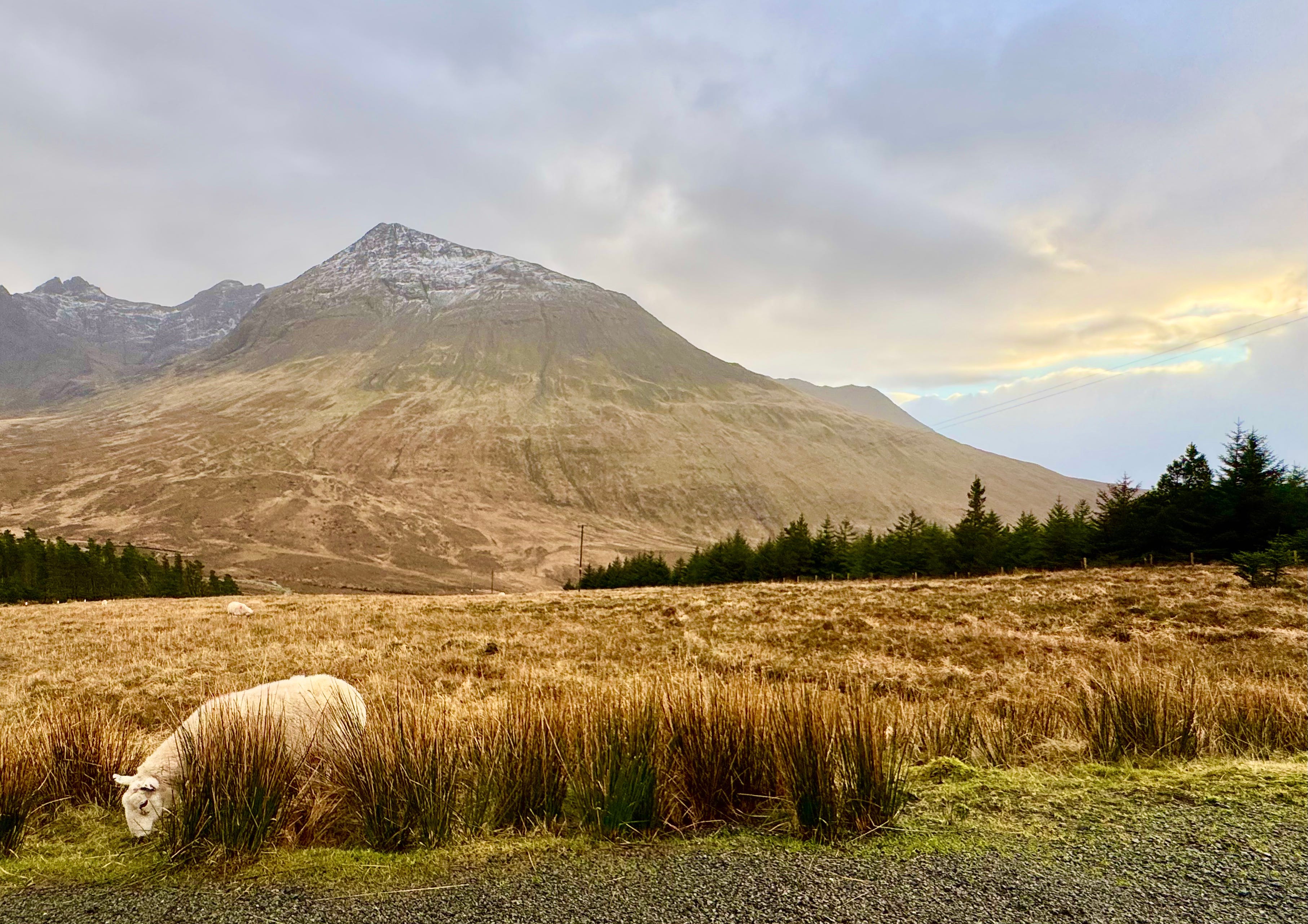
A grazing sheep in front of the Cuillin Mountains on the Isle of Skye, December 2024.