

I spent the last few days savoring a place I once called home, and to this day, still call home, even when I’m not here. This is a place I lived when I was eleven, twelve, and thirteen, and have carried with me every year since. And while I’ve been living in Scotland, I’ve only been about an hour flight away, meaning, I’ve been able to soak up more regular time there.
There are so many things in this place that make my heart swoon—from the fields that are knit together like quilted patchwork to the historic architecture to the familiar cobblestone streets and Dutch signposts. But nothing, and truly, I mean nothing, has stayed with me the way that the fields here have. More specifically, the fields I used to walk to from my front door.
As a preteen, when emotions and life felt all too big and overwhelming for me to know how to regulate, I’d walk out my front door, turn right, and head to the fields. About half a mile in, I’d reach a sign indicating I was stepping into Germany, almost like a threshold inviting me to stumble out of where I was and into something new.
And while everything in my body would be screaming (or crying), I’m dysregulated and I long to feel regulated!, my thinking brain had no idea what regulation or dysregulation was. I was just a kid. Still, beneath (or beyond?) verbal language, my body knew what I needed, even if I couldn’t put words to it.
One foot in front of another, I’d walk out to those fields, lulled by their level sturdiness, grounded by their earthy smells, feeling steadier step by step. The expansiveness before me that wrapped all around my body gave me the spaciousness I needed to exhale and to feel whole. Simultaneously, the growing crops and grasses, and the trees sprinkled alongside the walking paths were like anchors in what seemed to be an unending sea of gold and green. And one particularly round tree was like the epicenter of it all. I would find my way to her, feeling calmed, feeling clear, feeling held, feeling at rest.
And as I’ve had the absolute joy of returning here for several walks and picnics this past week, I’ve been curious about the ways my relationship with this place has been an illustration of something called entrainment.
I learned about the concept of entrainment about a year and a half ago, and ever since, curiosities have been swirling around in my brain and body.1 In biology, entrainment has to do with two systems—two rhythms—syncing up with each other, making adjustments as they synchronize together.2 Coming from a French word (entrainer) meaning to draw or drag, this might look like moving water or wind carrying a leaf at the pace of its movement (think of leaves being dragged along in a moving stream or caught up in a swirling gust of wind).3
We experience entrainment every day as our circadian rhythms sync up with daylight and darkness around us, cuing when our bodies wake up or wind down. And while entrainment might look like one thing syncing up with the rhythm of something else, it can also look like two independent things—with their own independent rhythms—making adjustments to sync up with each other (think of how our walking pace often syncs up with another’s when we go on a walk with another person, or, fun fact, how our heart rate will often sync up with the heart rates of others we’re sitting in a room with, or, possibly most fun, think of synchronous fireflies!).
Over the years I’ve reflected on just how much those fields leveled me out when things felt like they were rising to be all too much, all too loud, and all too chaotic. In the same way that a soothing melody can beckon our breath into a gentler, slower cadence, or an upbeat song can pump us up into a faster heart rate, the spacious sturdiness of those fields lulled me into feeling grounded and free. Back when I was a kid, I genuinely had no idea I was dysregulated and becoming regulated, I didn’t even know what those words meant. I simply followed my feet and knew in my bones that walking out to that place allowed me to exhale and anchor. Something in my bones knew there was a different rhythm from the one I felt stuck in, a different song that I could move into and move with, longing for the cadence and tones of those fields.
To be clear, I’m not trying to perfectly engage the biological concept of entrainment here, although it has very real implications for how our bodies regulate and interact with the world around us, including with other people in our relationships. Rather than getting lost in the weeds of precisely what’s happening biologically, I’d love to get curious about both the things we can measure biologically, and the things we don’t (at least not yet) have ways to measure with as much precision.
Through a parts-work lens, we might think of this as the ways that certain parts of us do—or don’t—sync up with the parts of another person we’re interacting with. From an embodiment perspective, we might think of this as the ways our thinking brain is—or isn’t—in sync with what’s happening in our body, which has layers and layers of curiosity to consider as our internal rhythms intersect with the internal rhythms of others. How does another’s anxiety impact what we’re experiencing in our body? How does our anger or grief impact what another experience’s in their body? How does the way that we’re wired, neurodiversity, or impacts of trauma find each other and figure out a synchronous rhythm (or a not-so-synchronous rhythm) that impacts our experience in relationships with others?
I say all this to land here: I have a hunch, mainly as a human, but also as a therapist, that it’s fair to say most of us are going about our lives longing to feel connected, seen, and understood, and that those things happen when some sort of ‘syncing up’ happens with another—like two rhythms that find a way to move together. And when the things we long for (feeling connected, seen, and understood) aren’t happening, there’s something off, there’s some sort of disconnect rather than a sense of ‘syncing up’—the rhythms aren’t finding a way to move together.
Some sort of syncing up involves rhythms finding each other and moving together, like cadences and harmonies that weave and coalesce together. And the absence of syncing up might instead feel like getting your foot stepped on by a dance partner or hearing a loud “wrong note” at the “wrong time” that’s out of step with the rest of a moving melody. And those sentences right there get to the heart of some of my curiosities with this…
I love how embodied and visual it is to imagine these things in terms of rhythm and movement. Rather than some ambiguous non-physical thing that happens (or doesn’t happen) when we do (or don’t) connect with another, the concept of entrainment brings to life what’s happening as we interact with world around us—with people, places, spirituality, and more.
For me, this invites me to visually imagine rhythms that are (or aren’t) syncing up with each other. Just as I can see the sturdy spaciousness of the fields in the Netherlands with my eyes, in the imagination of my mind I can sketch out the impact of that place on my body. I can imagine a knot of anxiety in my gut loosening into rest—into the level ground of those fields. I can envision heightened stress in my shoulders melting—soothed by the soft sway of the windmills sprinkled throughout those fields. I can picture shallow breaths that felt stuck high in my chest making their way down into my abdomen for a nice deep belly breath—anchoring into the tree roots that run into the earth alongside those fields.
And in our relationships, we can imagine an interplay of what’s happening within ourselves and what’s happening within another—picturing the rhythms we’re bringing with us as we intersect. And then, in the imagination of our minds, we can sketch out shapes, colors, images (or cartoons or animals) that depict the ways our colliding rhythms do—or don’t—find synchronicity.
Alright, deep breath… While I’d love to press on for about 2,000 more words about how this plays out in relationships, for today, I’ll leave us with these thoughts…
What might it look like to get curious about the rhythms and movements that (1) we bring with us into relationships, (2) that others bring with them, and (3) how these rhythms and movements coalesce into a symphony—or, instead, what might feel like a chaotic chorus of screeching cats?
When I get curious about this interplay that is—or isn’t—syncing up, how do I envision it in my imagination? What is it like to be curious about how my mind sketches this out, even if I can’t make sense of those visuals logically? What symbols, shapes, or images pop up naturally, even if I don’t know why?
More thoughts to come… For now, please enjoy the picture below of the very place I described in this post.
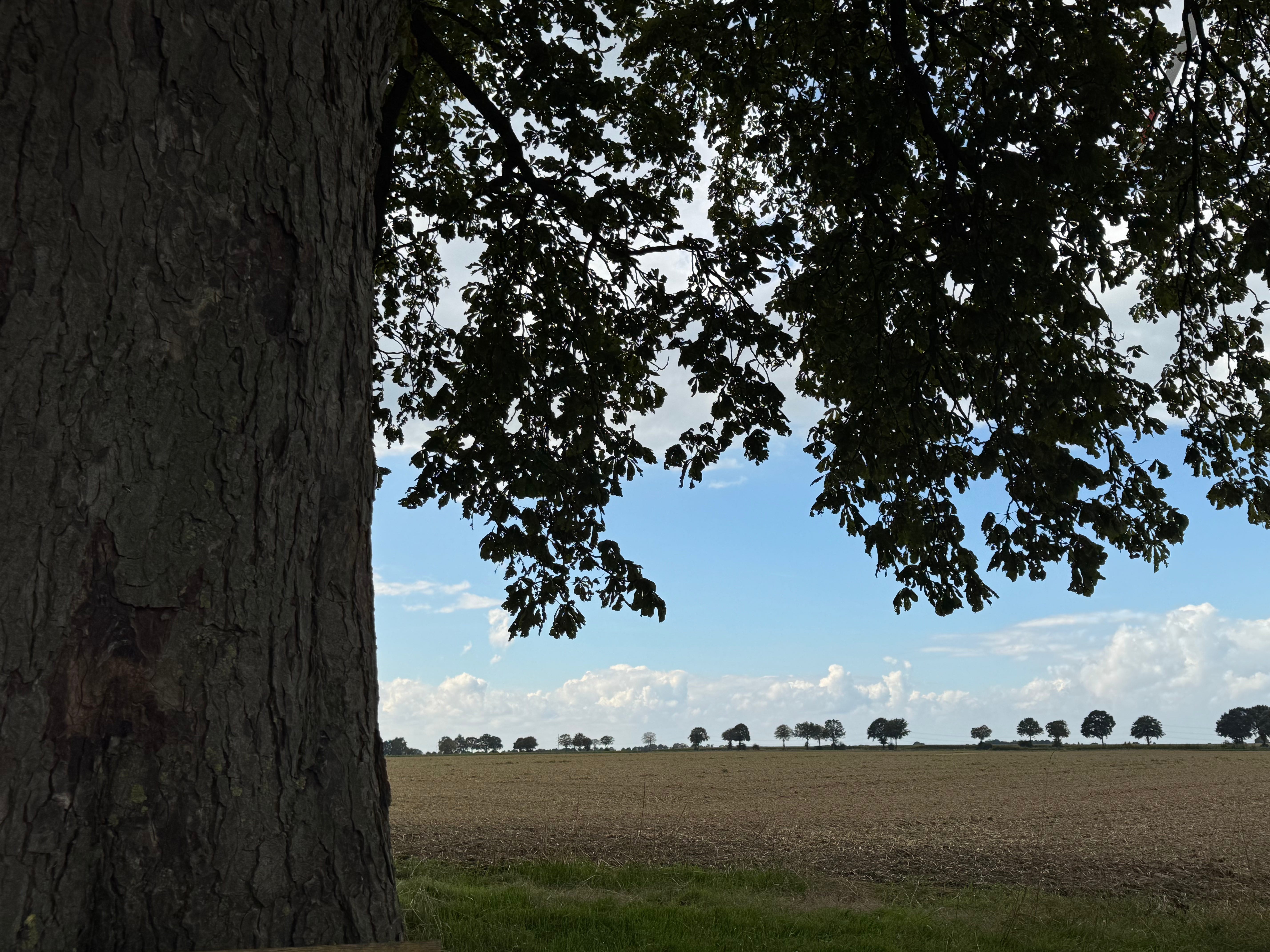
Picnic at the tree, September 1, 2026
I learned about entrainment while researching how the Rest and Restore Protocol (RRP) works, which is a therapeutic intervention developed by Stephen Porges, the author of Polyvagal Theory. For more information about this intervention, see https://integratedlistening.com/products/rest-and-restore-protocol/
https://dictionary.cambridge.org/us/dictionary/english/entrainment
https://www.merriam-webster.com/dictionary/entrain
Very interesting research. My DIL Rachel is also a therapist I look forward to her perspective too!
Beautiful post! Cannot wait to lead the retreat with you. Imagining being in the Scottish countryside soothes my whole being.