

A couple of months ago, I saw ads for a documentary about saving the Scottish Wildcat.1 As a cat lover, I was curious to learn more about the efforts to save them from being critically endangered, and I have a hubby who loves a good documentary, so we started the series. While I anticipated adorable footage of these fierce Highland tigers, I did not anticipate what would happen inside of me watching their journey. Spoiler alert, it included endless tears and weeks of unending reflection that I can’t get out of my bones—reflections that I want to share with you here. Before I jump there, let me set the scene. I promise the build up will be worth it :)
The series takes you through years of careful preparation and strategic steps to prevent the Scottish Wildcat from becoming extinct, something that’s become a genuine risk. Footage shows you how the wildcats are cared for in a sanctuary, and then every stage from those enclosures, to creating new little lives, to their reintroduction to the wild.2 And as wildlife conservation is not my field, let me say, please forgive me for any missteps I might make in terminology or description here…
The reality of the story’s starting point for these felines is that their numbers have dwindled to nearly nothing. So watching their conservation and pre-release care is not just watching the rehabilitation of an injured animal—it’s witnessing intentional care to foster flourishing for a whole population that’s been in Britain since the last Ice Age.
Rather than treating these Highland tigers like the house-cats they look like to the untrained eye, experts create homes that are as wild as possible, preparing food as wild as possible, and consider how each step of their development is not just personal growth of their little bodies, but also a relationship with the earth and elements around them—a relationship that must be cultivated apart from too much human interaction to prepare them for the wilderness they’ll be released in.
Following their time as adorably fluffy kittens, they’re moved into pre-release enclosures, a space that’s meant to bring them one step closer to their truest home, providing the scaffolding they need to hone in necessary survival skills for free-roaming life in the Highlands.
And then, when they’re ready, they’re taken to a remote “soft-release” enclosure in the Highlands, like a landing spot to first smell their new home—their truest home—and start to press into that place beneath their paws. These soft-release enclosures are still contained for a short amount of time to allow for some acclimation to new sounds and smells, like a liminal linchpin before they’re launched.
And then, at long last, the final near-human interaction before they’re free to be fully wild, is the unlocking and opening of a door, providing a portal from a contained life to a life unbound.
Now, this part of the story wasn’t a surprise. The documentary made clear this is where the narrative was going—it was the whole point. Still, something in my body was not entirely prepared for what I was about to witness. Perhaps more accurately, something in my body was not entirely prepared for the sacredness of what I was about to witness.
With cameras set up for the team of humans to follow the outcome of their years-long efforts, they watch from a car in the distance. The documentary shows the footage of these cameras, along with the team’s reactions as they’re watching in realtime.
It’s in this scene that the first of the wildcats steps out of her soft-release enclosure. Her paws reach forward onto a branch, a bridge connecting the only kind of world she’s ever known—enclosure—to the open wild world that is her home. Rather than looking scared or anxious, she stands tall, as if her bones know this is where she belongs. And it’s as she steps out onto this branch toward the expansive Scottish landscape around her that the words, bold cat, fall out of the mouth of one of the team members watching these steps in realtime, from a car in the distance.
Now, I need to back up a moment and say, during the build up to the final release, I could sense something stirring inside. It’s not uncommon for me to cry at movies and documentaries. It’s actually a joke in my family that my mom, sisters, and I can all easily start blubbering just 30-seconds into a well-produced trailer. But this was different, the force and tone of this emotion brewing beneath the surface resonated at a distinct register.
Minutes later, as the wildcat took her first steps home, this emotion erupted into feral tears that could not be contained. Now, my husband is used to me crying at tv shows and movies. He’s also used to me being loud and expressive and unfiltered in my emotions, which is important to understand for what he said next. My entire body was so uncontrollably wrecked by what I was witnessing that he gently, but seriously, asked me, “Do we need to stop watching?”
He could see that something was happening beyond my usual being-moved-by-a-story tears. And even though I didn’t quite understand what it was at that moment, the answer for me was a simple, “No.” I wanted to witness what I was witnessing, and feel what I was feeling, even if I didn’t understand it. Because even though I didn’t understand it, I knew it was significant.
In the moment, as I tried to make sense of what was happening, I had some thoughts scurry through my mind. I couldn’t help but think of the opening story of Glennon Doyle’s Untamed, depicting a cheetah in captivity who’s reduced to chasing a dirty pink bunny and moments of returning to her wild instincts when she’s not set to perform. It was as though something in my brain was trying to parse through whether this was the same, or if it was something different.
Yes, both had a cat.
Yes, both cats were ultimately wild.
Yes, both had themes of wild and captivity.
But that cheetah only had glimpses—tastes of her wildness—and was most likely confined to captivity for the rest of her life, with only the imaginative flip-side of an untamed life to contrast with her containment.
And instead of having performance or captivity ahead of her, this bold wildcat freely stepped into the Scottish Highlands. And represented so much more than her one being. She was part of a long lineage of striped felines who were nearly extinct—with estimates that had reached as low as 35 Scottish Wildcats left only a couple of years earlier.3 Her steps were an embodiment of hope and movement into a different kind of future, one that moves away from the extinction of these wildcats, and instead, advocates for, promotes, and celebrates their flourishing and freedom. One where harmful, oppressive, and lethal interference with their flourish and freedom is taken seriously and understood for what it is. From this bold cat’s first steps, this project has seen an incredible success rate in the survival of these wildcats,4 including 24 (known) kittens born in the wild to released females in one year-cycle alone.5
And something about these nuances, these distinctions, poked corners of my soul that run far beneath intelligible speech.
I was moved by the care and concern to not let these Highland tigers simply disappear—the way they were seen, valued, and advocated for, despite the fact that they will never offer gratitude or repay these teams for their efforts.
I was struck by the echoes of home and belonging that resounded from this cat’s silent footsteps (or should I say paw-steps?). It was like a stake in the ground was anchored and settled in its rightful home. Like a critical puzzle piece perfectly placed where it so clearly belongs.
And, a curiosity was piqued about what we might learn from these wildcats and their journey. Not so much a sense of how can we make this about us, but how can get out of our own head, our own confines, and let their wildness teach us something we might not learn in our own bounds?
What could be our truest home that we might also step into, boldly, if we had a branch to bridge between the place we find ourselves, and the place our bones most long for?
What might the branch be?
What have we mistaken as our home, instead?
What difference would it make to become reacquainted with wildness, not only within, but also, around us?
And how might we become reacquainted with wildness, not only within, but also, around us?
These questions (and more!) are ones I want to continue chewing on—and as a spoiler alert, reflections on these wildcats deepened as they intersected with wisdom from the brilliant Sharon Blackie, who I got to spend a week with contemplating place as a teacher, what it means to be rooted, different types of belonging, connections between stories and place, and more… now just to find time to keep writing :)
For today, I’ll pause here, and leave you with this little poem that I wrote about witnessing that bold cat taking her first steps into her truest, wild-Highlands home. And fun fact, there’s a whole section here on acseiple.com of me Playing with Poetry. If you want to check out more of these wild-written words, check them out here. For me, this has been a bit of a practice of exploring wildness not only within, but also around.
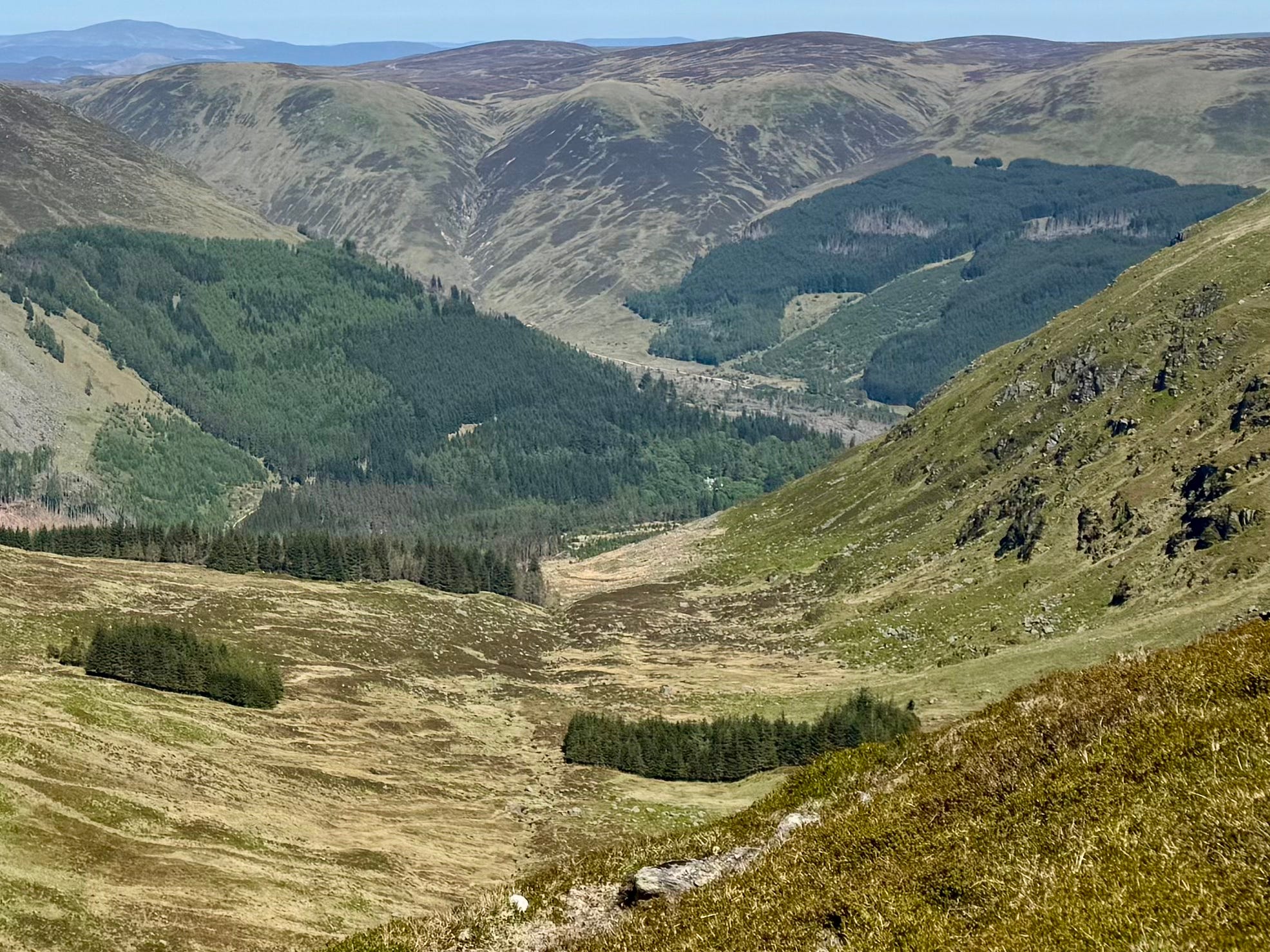
Hiking down from Driesh, Corrie Fee Nature Preserve in the Cairngorms National Park, May 2025.
https://www.bbc.co.uk/programmes/m0026r4v.
For more information about the Saving Wildcats Project, visit https://www.savingwildcats.org.uk/.
https://www.nationalgeographic.com/animals/article/scottish-wildcat-highlands-tiger-conservation-news#:~:text=No%20one%20knows%20exactly%20how%20many%20are,Some%20put%20the%20exact%20number%20around%2035.
https://www.savingwildcats.org.uk/media/tntfclye/langridge-et-al-2025.pdf.
https://www.savingwildcats.org.uk/news-events/2025/september/wildcat-wrap-up-another-successful-year-of-wildcat-conservation-in-scotland/.